← Yongzhong Xu

Mechanistic interpretability · note

Spectral fingerprints of an attention circuit during pretraining

TL;DR. An unsupervised spectral signal — the participation ratio (effective rank) of each head’s attention output, tracked over training — pre-identifies causally-relevant attention heads without labels, ablation runs, or attention-pattern inspection. The method has now been validated across an ~20× parameter-scale range (51M synthetic up to OLMoE 1B-7B), three pretraining datasets (Pile, FineWeb, DCLM), and two architectures (dense transformer and 64-expert top-8 MoE).

Headline cross-architecture findings:

1. A 3–4 head induction circuit is identified in every model tested — including all three 1B-class models (Pythia 1B, OLMo 1B dense DCLM, OLMoE 1B-7B MoE DCLM) — via an all-head capability-specific screen at induction-selectivity ≥ 50×. Ablating that small set tanks synthetic induction from ~5% to ~0% in every model; natural-text ablation produces a 5–7× differential effect over matched-random in the same layers.

2. L0 and L1 have zero BOS-classified heads across all five natural-text models (Pythia 160M / 410M / 1B; OLMo 1B; OLMoE 1B-7B). Universal architectural property of decoder-only LMs at 100M+ scale: the first two layers do diverse general-purpose computation; the BOS attractor only kicks in from L2 (DCLM data) or L4–L6 (Pile data) onward. Where it kicks in is data-dependent; the L0/L1 zero-BOS floor is conserved.

3. Three independent drivers of whole-model BOS fraction: scale grows BOS within the Pythia family (43% → 58%, saturates near 54% at 1B); DCLM data adds ~20pp over Pile at same scale+architecture; MoE reduces BOS by ~10pp vs dense at same scale+data. Attention sinks are widespread but not MoE-caused.

4. Methodology pivot at BOS-dominated scale: integral-top-K ranking surfaces BOS-saturated heads first when ~70%+ of heads classify as first-token; the all-head capability-specific screen (measure capability-X selectivity in isolation, ablate the full set with selectivity ≥ 50×) is the robust approach. Both methods agree at small scale; the screen extends the same causal claim to 1B+ models where rank-by-integral saturates.
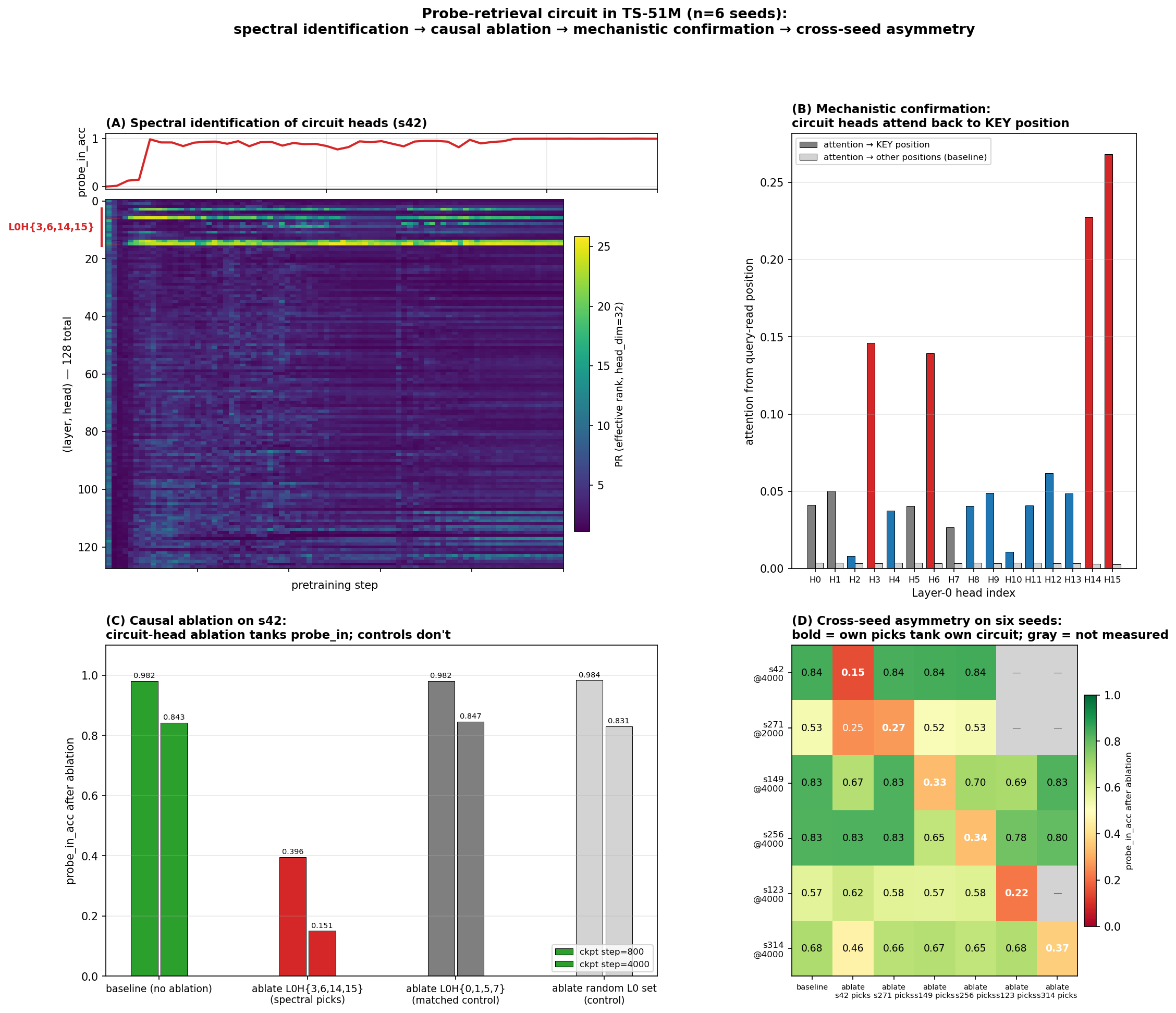
Per-head participation ratio during TS-51M pretraining identifies four L0 attention heads as the retrieval circuit on seed 42; causal ablation confirms 42–95× selectivity to the retrieval target.

Why this matters

Mechanistic interpretability typically identifies attention circuits after they emerge, by ablating heads and inspecting attention patterns to see which were doing the work. That’s expensive (one full forward-and-eval pass per condition) and post-hoc (you need a fully-trained model and a target capability to define the ablation).

The signal in this paper is different: it’s read off per-head, per-checkpoint, during training, with no task-specific labels. A head that develops content-dependent attention during a capability-emergence event has its singular-value spectrum collapse from rank-1 (one default direction) to rank-k (one direction per content variation). That collapse is what we measure.

The interesting question is whether the signal is real and general — whether it reliably points at heads that ablation would confirm causally implicated, across different seeds, different scales, and different capabilities. The four results below address that.

The setup

We pretrain TS-51M (8 layers × 512 dim × 16 heads, ~51M parameters) on TinyStories with periodic injection of a long-range key-retrieval task. Each “probe example” has the structure

[prefix...] The secret code is XXXX. [...filler...] What is the secret code? XXXX
                                ^                                              ^
                              KEY pos                                  QUERY pos (target)

where XXXX is a randomly-chosen single-token codeword from a fixed 512-codeword vocabulary. The model must use the early KEY mention to predict the codeword at the QUERY position. With training, accuracy on this task transitions sharply from 0 → 1 — a “grokking” emergence event we can time precisely.

The unsupervised method

For each pretraining checkpoint and each (layer, head) pair, we extract the per-head attention output at the QUERY-read position over a fixed batch of 2000 probe examples. The result is a [2000, head_dim=32] matrix per (layer, head, checkpoint). We compute its singular-value spectrum and report the participation ratio

$$\mathrm{PR} \;=\; \exp\!\big( H(\sigma^2 / \!\sum \sigma^2) \big)$$

a smooth, differentiable measure of effective rank.

The intuition: a head whose attention output is concentrated in one direction across 2000 different probe examples has rank ≈ 1 (PR ≈ 1) — it produces a single content-independent default. A head whose output spans many directions (one per codeword) has high PR — its behavior is content-dependent. With 512 codewords, content-saturated PR sits near 22.

Why should QK becoming content-dependent imply this PR signature? Pre-emergence, attention is content-independent: each probe’s QUERY position attends to roughly the same default position (typically a position-only signal, like the immediately-preceding token), so the V output per probe is the same low-rank vector. Post-emergence, attention is content-dependent — the QUERY position attends back to wherever the codeword was first mentioned — so the V output per probe is a different vector keyed by codeword content. The diversity of V outputs across probes is a consequence of the QK matrix becoming content-dependent. We measure this consequence with PR.

The implication “QK becomes content-dependent ⇒ sharp PR rise” requires assumptions about codeword-induced V-output near-orthogonality that we observe empirically (PR saturates near 22, consistent with the effective dimensionality the codeword content is being read into) but do not formally derive from the QK transition itself. Treat this as the operative mechanistic story; the empirical signature is what we measure, and the formal derivation is open work.

Spectral identification on six seeds

We apply the method to six seeds (s42, s271, s149, s256, s123, s314) trained at identical hyperparameters except the RNG seed. For each, the spectral signal points at a different small set of heads with sharp PR transitions during behavioral grokking:

SeedSpectral picks (PR-spread top set)Where
s42L0H{3, 6, 14, 15}L0 only — every other head has spread < 12
s271L6H{1, 10} + L7H{9, 15}late layers — no L0 head exceeds spread 11
s149L6H{2, 5, 6, 7} + L7H{13}late layers, different specific heads than s271
s256L5H10 + L6H{2, 4} + L7H{6, 13}spans L5/L6/L7, shares L6H2 + L7H13 with s149
s123L5H5 + L6H{5, 11} + L7H{2, 4, 13}spans L5/L6/L7, shares L6H5 + L7H13 with s149, L7H13 with s256
s314L5H{7, 14, 15} + L7H{0, 5}L5+L7 only (no L6 picks!), distinct from all others

PR-spread values for the picks range from ~20 to ~24 (per head). For comparison, every non-pick head in every seed has spread ≤ ~14. The signal-to-noise gap is wide on the synthetic probe task.

The transition timing is also striking: PR minima fall at step 400 (when probe accuracy first becomes nonzero), peaks at steps 800–1000 (when probe accuracy reaches 0.5–0.92). The spectral signal precedes and tracks the behavioral emergence event.

Cross-seed sharing pattern at n=6:

So at n=6 the picture is: each seed has a small set of strongly-transitioning heads, with partial cross-seed sharing that grows with sample size (n=2: no shared heads; n=4: 2 shared heads in one pair; n=6: shared heads in 3 pairs, with one head recurring across 3 seeds). The seed-to-seed variation is real but bounded — there’s some convergence on a small pool of “preferred” late-layer heads (especially L7H13), but plenty of seed-specific picks too.

This is the central methodological claim: the spectral signal identified a partially-different set of heads on each of six seeds without any task-specific labels — and as the next section shows, the heads it picked are exactly the heads ablation confirms causally responsible.

Causal verification

Zero out the spectrally-identified heads on a fully-trained checkpoint and measure probe accuracy. The cross-seed asymmetry is the load-bearing observation:

s42 ablations (step 4000, baseline pin 0.843):

Conditionprobe_in_acc
baseline0.843
ablate s42 spectral picks: L0H{3, 6, 14, 15}0.151 ← circuit destroyed
ablate s271 spectral picks: L6H{1,10}+L7H{9,15}0.838 ← no effect
ablate s149 spectral picks: L6H{2,5,6,7}+L7H130.840 ← no effect
ablate s256 spectral picks: L5H10+L6H{2,4}+L7H{6,13}0.844 ← no effect
ablate matched-size L0 control: L0H{0, 1, 5, 7}0.831
ablate ALL 32 heads in L6+L70.826
ablate all 16 L0 heads0.129

s42 is L0-only: every late-layer ablation (s271, s149, s256 picks; even all 32 L6+L7 heads) leaves probe accuracy at baseline; only L0 ablations matter.

s271 ablations (step 2000, baseline pin 0.526):

Conditionprobe_in_acc
baseline0.526
ablate s271 spectral picks (L6+L7)0.273 ← own circuit destroyed
ablate s42 spectral picks (L0H{3,6,14,15})0.251 ← s42’s L0 picks ALSO matter
ablate s149 spectral picks: L6H{2,5,6,7}+L7H130.515 ← no effect (no shared heads)
ablate s256 spectral picks: L5H10+L6H{2,4}+L7H{6,13}0.525 ← no effect (no shared heads)
matched-size random L6+L7 control0.518

s149 ablations (step 4000, baseline pin 0.832):

Conditionprobe_in_acc
baseline0.832
ablate s149 spectral picks (L6H{2,5,6,7} + L7H13)0.329 ← circuit destroyed
ablate s42 spectral picks (L0H{3, 6, 14, 15})0.668 ← L0 substrate matters
ablate s271 spectral picks: L6H{1,10}+L7H{9,15}0.830 (no overlap)
ablate s256 spectral picks: L5H10+L6H{2,4}+L7H{6,13}0.698 ← shares L6H2+L7H13
ablate s123 spectral picks: L5H5+L6H{5,11}+L7H{2,4,13}0.691 ← shares L6H5+L7H13
ablate s314 spectral picks: L5H{7,14,15}+L7H{0,5}0.828 (no overlap)
ablate ALL 32 heads in L6+L70.150

s256 ablations (step 4000, baseline pin 0.827; step 10000, baseline pin 0.945):

Conditionpin @ 4000pin @ 10000
baseline0.8270.945
ablate s256 spectral picks (L5H10+L6H{2,4}+L7H{6,13})0.335 ← destroyed0.812
ablate s42 spectral picks (L0H{3,6,14,15})0.8290.605 ← L0 matters at saturation
ablate s149 picks (share L6H2 + L7H13)0.645 ← −0.180.922
ablate s123 picks (share L7H13 only)0.779 ← −0.05n/a
ablate s271 picks (no overlap)0.8320.947
ablate s314 picks (no overlap)0.802n/a
ablate ALL 48 heads in L5+L6+L70.1180.134

s123 ablations (full-trained to step 10000, baseline pin 0.998 at step 10K):

Conditionpin @ 4000pin @ 10000
baseline0.5710.998
ablate s123 spectral picks (L5H5+L6H{5,11}+L7H{2,4,13})0.217 ← destroyed0.992 (saturated)
ablate s42 spectral picks (L0H{3,6,14,15})0.621 ← NO EFFECT0.997 ← STILL NO EFFECT
ablate s149 picks (share L6H5+L7H13)0.571n/a
ablate s271 picks (no overlap)0.578n/a
ablate s256 picks (share L7H13 only)0.584n/a
ablate ALL 48 heads in L5+L6+L70.0920.144

s314 ablations (step 4000, baseline pin 0.680; step 10000, baseline 0.889):

Conditionpin @ 4000pin @ 10000
baseline0.6800.889
ablate s314 spectral picks (L5H{7,14,15}+L7H{0,5})0.367 ← destroyed0.862 (saturated)
ablate s42 spectral picks (L0H{3,6,14,15})0.461 ← −0.220.666 ← −0.22
All other cross-seed picks (no overlap)~baseline~baseline
ablate ALL 48 heads in L5+L6+L70.0990.292

Five things to read off these tables (n=6):

  1. The spectral picks for each seed carry the circuit on that seed. Diagonal entries — own-seed picks ablation — produce the largest seed-specific drop in every case (s42: 0.84→0.15; s271: 0.53→0.27; s149: 0.83→0.33; s256: 0.83→0.34 at step 4000; s123: 0.57→0.22; s314: 0.68→0.37). Same-size random and matched controls have ~zero impact.
  2. L0H{3, 6, 14, 15} is a near-universal retrieval substrate, with one clean exception. Ablating that set causes a substantial drop on s42 (−0.69), s271 (−0.27), s149 (−0.16), s256 (−0.34 at step 10K), and s314 (−0.22). But on s123 it has zero effect, even at step 10000. A focused investigation showed that L0 itself is not dead on s123 — ablating all 16 L0 heads tanks pin (0.998 → 0.214) AND val_loss (1.44 → 3.70). L0 is doing essential general-LM work on every seed. The exception is in retrieval: 5 of 6 seeds additionally use L0H{3,6,14,15} as a retrieval substrate that the spectral signal flags as L0-localized on s42; s123 routes retrieval entirely through late layers (L5/L6/L7) without recruiting any specific L0 head as a retrieval team-member. So the falsified hypothesis is “L0 is the universal retrieval substrate”; the surviving claim is “L0 is the universal general-LM substrate, but most-seeds-but-not-all also use L0 specifically for retrieval.”
  3. Cross-seed sharing is real and proportional to overlap count. When two seeds share specific heads, ablating one’s picks on the other produces an effect proportional to the number of shared heads:
    • s149 ↔ s256 share 2 heads (L6H2, L7H13) → effects of 0.13–0.18 each direction
    • s149 ↔ s123 share 2 heads (L6H5, L7H13) → effects ~0.14 each direction
    • s256 ↔ s123 share 1 head (L7H13) → effect 0.05 (smaller, as predicted)
    • s271 ↔ anyone, s314 ↔ anyone: no shared heads → no cross-seed effect
    This is a clean dose-response — the spectral signal sees each seed’s full late-layer team including the shared parts.
  4. L7H13 is recruited independently by 3 of 6 seeds (s149, s256, s123). Whatever computation L7H13 implements on this task, it’s evidently the kind of computation that can be re-discovered across different random initializations more often than chance — though far from universal (s271 and s314 don’t pick it, and s42 doesn’t even use late-layer heads).
  5. Spectral identification is partial-but-aligned. The signal correctly picks heads that are causally implicated, on every seed. What it does not always do is pick the complete causal circuit when one component (L0) is shared and another (late layers) varies — so spectral picks are a sufficient identification of the seed-specific circuit but not a complete identification of the full computation. (For s123, where L0 doesn’t matter, the spectral picks ARE the complete circuit.)

The picture at n=6: most seeds use L0 substrate + seed-specific late-layer team (with partial sharing of specific heads, especially L7H13). One seed (s42) uses only L0; one seed (s123) uses only late layers, no L0. So both ends of the L0/late-layer spectrum exist in the seed distribution.

Mechanistic confirmation

What do the four L0 heads actually do? Measure each L0 head’s attention from the QUERY-read position back to the KEY position (averaged over 200 probe examples):

Headattention → KEYselectivity (KEY vs uniform-other)
L0H30.14644×
L0H60.13942×
L0H140.22876×
L0H150.26895×
(every other L0 head)< 0.07< 17×

The four circuit heads are induction-style retrieval heads: at the query position, they attend back through the context to find where the codeword was first mentioned. The retrieved content (the codeword embedding via the V projection) gets written into the residual stream and flows through downstream layers to the output prediction.

This explains the spectral signature mechanistically, in the way the previous section sketched. Pre-emergence the heads attend to a single default position regardless of probe content (V output near-rank-1, PR ≈ 2). Post-emergence the QK has become content-dependent, attention follows the codeword, and the V output diversifies across probes (PR ≈ 22).

The late-layer picks are also KEY-attending heads — directly measured. Running the same query→KEY attention measurement for each seed’s spectral picks (at ckpt step 4000):

SeedSpectral picksmean selectivitymax selectivity
s42L0H{3,6,14,15}64×L0H15 = 95×
s271L6H{1,10}+L7H{9,15}138×L7H15 = 190×
s149L6H{2,5,6,7}+L7H13262×L6H5 = 333×
s256L5H10+L6H{2,4}+L7H{6,13}161×L7H13 = 276×
s123L5H5+L6H{5,11}+L7H{2,4,13}125×L7H2 = 256×
s314L5H{7,14,15}+L7H{0,5}128×L7H5 = 140×

All 24 spectral picks across 6 seeds are confirmed KEY-attending. Notably the late-layer picks have higher selectivity than s42’s L0 picks — induction-style retrieval at higher layers is sharper, perhaps because the residual stream there carries cleaner content-tagged information.

Side observation: in each distributed seed, the spectral signal picks 4–5 heads but the model has ~10–12 KEY-attending heads in the active layers. The signal preferentially flags the sharpest-transitioning subset of the KEY-attending pool. Heads with high KEY-attention but lower PR transition spread are not flagged — consistent with the “ablate full L6+L7” results, which tank probe accuracy more than ablating just the spectral picks. So the spectral picks are a high-precision (all are real induction heads) but moderate-recall identification of the broader retrieval circuit.

So the cross-seed observation is same task, same mechanism (KEY-attending retrieval), different layer placement and different specific heads at each placement.

How this connects to the spectral-edge program

This piece doesn’t stand alone — it’s the empirical-interpretability counterpart to a longer program studying what kind of structure the spectral signal in transformer training actually picks up. That program’s earlier results argued that spectral gap dynamics in the rolling-window parameter Gram matrix precede grokking events under weight decay (and don’t, without it), and — separately — that standard sparse-autoencoder attribution methods do not preferentially identify directions in the spectral-edge subspace. Together those left an open question: if SAE attribution is missing this structure, is what it’s missing mechanistically real, or is it just an optimization-geometry artifact that doesn’t correspond to anything circuit-shaped?

This piece answers half of that. The same kind of spectral signal — applied per-head, per-checkpoint, on activation rather than parameter space — pre-identifies the causally-relevant heads of a specific behavioral capability on independent seeds where the heads themselves differ. Together the two pieces form a coherent two-step claim: spectral structure carries information SAE attribution misses, and what it carries is mechanistically real circuits, not optimization artifact, not noise. The methodological piece (a per-head spectral monitor) plus the substantive piece (the heads it identifies are the heads ablation confirms causally) is a stronger argument together than either in isolation.

Direct cross-check on s42 (head-restricted parameter Gram). We tested the connection more directly: at each checkpoint up to step 2000, extract the L0 Q/K/V parameter rows for the circuit heads {3, 6, 14, 15} and the matched-control heads {0, 1, 5, 7}, build a rolling-window (W=10) Gram of consecutive deltas, and compute its signal-weighted spectral gap. Both surfaces show the circuit-vs-control contrast: at step 1250 the activation-space PR ratio is 6.2× (circuit / control), the parameter-space gap ratio is 1.96×; the same direction is sustained throughout step 950–1750. The contrast is much sharper in activation space (~7×) than parameter space (~1.6×), but qualitatively both signals point at the same heads.

Direct cross-check on s42: activation-space PR ratio vs parameter-space spectral gap ratio for circuit heads {3, 6, 14, 15} vs matched-control heads {0, 1, 5, 7}. Both surfaces point at the same heads.

We do not see clean temporal precedence in this analysis (the activation transition completes by step 800; our checkpoint cadence is too sparse before that to get a window-10 gap signal in the same window — first parameter-space data is at step 950). So this is a “consistent with” result, not a strong claim of “two surfaces of one underlying signal.” The full claim would need denser early checkpoints and a full-model Gram (rather than head-restricted), which is a natural follow-up.

Cross-scale validation: GPT-2 124M, Pythia 160M, Pythia 410M

We tested whether the spectral signal generalizes from the synthetic probe task to natural-text capabilities, and whether it’s portable across (data, training procedure, RNG, codebase, scale). Three independently-trained natural-text models were used: Karpathy 124M (12L × 768d × 12h) trained on FineWeb-10B; EleutherAI Pythia 160M (12L × 768d × 12h) and Pythia 410M (24L × 1024d × 16h) trained on the Pile. No probe injection. For each pick, we ran a 6-class capability survey (induction, previous-token, duplicate-token, first-token / BOS, self, local) and classified each pick by its highest-selectivity class against the uniform-other baseline.

Capability survey on GPT-2 124M: top-30 spectral picks classified into 6 capability classes, with precision-at-k results and class breakdown.

Precision-at-k across all three models:

kKarpathy 124M (FineWeb)Pythia 160M (Pile)Pythia 410M (Pile)
5100%100%100%
10100%100%100%
15100%93%93%
3093%93%90%
5090%
80 (matched)81%

k should be scaled to total head count. Karpathy 124M and Pythia 160M each have 144 heads (12L × 12h); Pythia 410M has 384 heads (24L × 16h). At a fixed absolute k, the table compares different fractions of model capacity (k=15 on 144 heads is ~10%; on 384 heads it’s ~4%). The fair comparison is at head-count-matched k or at each model’s natural elbow in the PR-integral distribution:

ModelTotal headsElbow kElbow / totalPrecision at elbow
Karpathy 124M1443020.8%93%
Pythia 160M1442316.0%~93%
Pythia 410M3847018.2%~90%

The elbow sits at ~16–21% of total heads in every model — a model-agnostic cutoff, no need to pick k by hand. Match within 1–3 percentage points across an 8× parameter scale range and two completely different training pipelines. The methodology generalizes.

The conserved fraction (the headline finding)

When we extend Pythia 410M’s classification to top-80 (head-count-matched to top-30 on the 144-head models) and look at fraction of heads classified into a known capability class:

ModelTotal headsk (matched)ClassifiedFraction
Karpathy 124M144302819.4%
Pythia 160M144302718.8%
Pythia 410M384806516.9%

~17–19% of heads in a model do identifiable specialized computation, conserved across an 8× scale range. The capability count scales with model size; the fraction of heads doing specialized work stays constant. The PR-integral distribution has a natural elbow at the same fraction in every model — a model-agnostic cutoff for “heads worth investigating,” no manual k selection needed.

Pythia 410M extended capability survey: precision-at-k stays high through top-50; natural elbow in PR-integral distribution lands at ~18% of total heads, matching Karpathy 124M and Pythia 160M.

Cross-model invariant: every model has one super-prev-token head

Modelheadprev-token selectivity
Karpathy 124ML6H927,776×
Pythia 160ML3H281,792×
Pythia 410ML5H223,634×

Different layer in each model, but the PR-integral ranking finds it across all three. PR-spread misses all three — their trajectories are high-but-not-the-highest-spread. The recurrence suggests a real architectural regularity: there’s probably one degree of freedom per model that gets compressed into a single near-perfect prev-token implementation, and the methodology is sensitive enough to find it without knowing where to look.

Causal verification: distribution wins at scale

Ablation-based causal verification was run on each model. The targeting itself differs by scale:

ModelTargetingtop-1 drop
Karpathy 124Mtop-6 spectral picks (incl 3 induction heads)16% → 0.85% (−95%)
Pythia 160Mmech-interp-classified L8H2 + L5H04.7% → 0.05% (−99%)
Pythia 410Mtop-6 spectral picks (mostly self/prev)3.7% → 2.1% (−43%)
Pythia 410Mmech-interp + 2nd-class induction3.7% → 0.85% (−77%)
Pythia 410Mall heads with induction selectivity ≥ 50× (11 heads)3.7% → 0.0% (−100%)

On 124M, top-6 spectral picks happened to contain 3 induction heads, so spectral-picks ablation alone tanked induction. On Pythia 160M and 410M, top-6 picks are dominated by self/prev-token heads — and the mech-interp triangulation in step 2 of the workflow becomes load-bearing. Screening all 384 heads of Pythia 410M for induction selectivity ≥50× found 11 such headsmore than Karpathy 124M’s 6 — but at lower per-head selectivity (max 203× vs 124M’s 681×). Only 3 of the 11 were in the top-30 spectral picks.

The pattern: distribution wins, not dilution. Total induction “signal” is preserved across scale, just spread across more heads. The methodology fully captures the circuit when ablation targets the full capability-selective set (not just the spectral top-k).

Full details and methodological recommendations in INDUCTION_HEADS.md.

Cross-architecture extension: 1B-class models, MoE, DCLM

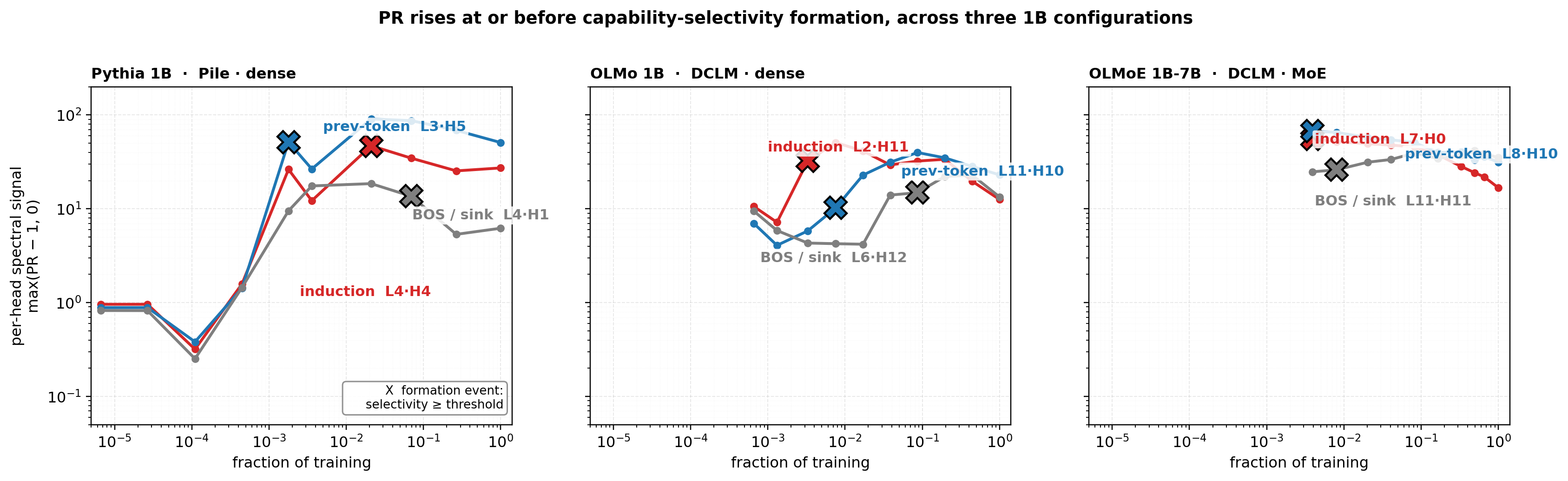
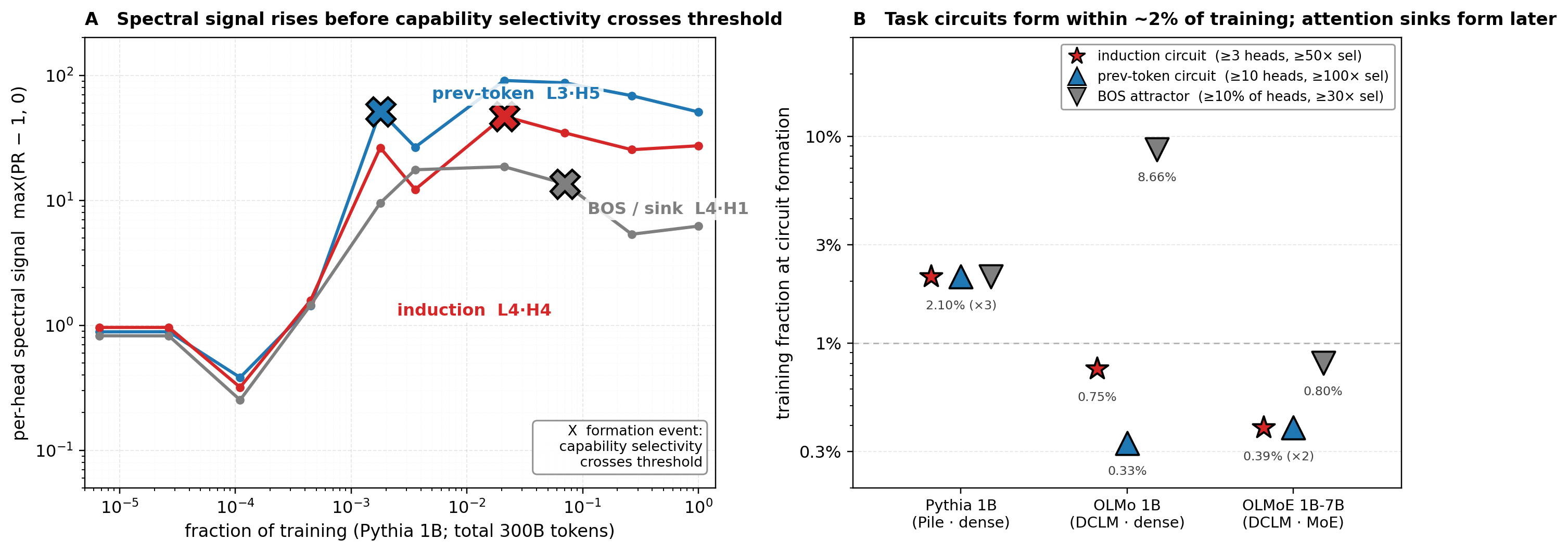
The next question: does the methodology port to (a) 1B-class scale, (b) a different architecture (mixture of experts), and (c) a different training distribution (DCLM)? We ran three new models on the same synthetic induction batch (RNG seed 42) and the same all-head capability-specific screen at induction-selectivity ≥ 50×:

ModelArchitectureDataVendor
Pythia 1Bdense, 12L × 12h (128 heads)The PileEleutherAI
OLMo 1B-0724-hfdense, 16L × 16h (256 heads)DCLMAllenAI
OLMoE 1B-7B-0924MoE (64 experts top-8), 16L × 16h (256 heads)DCLMAllenAI

Induction circuits replicate in every 1B model

The capability-specific screen at induction-selectivity ≥ 50× identifies a small 3–4 head induction circuit in every model. Ablating that set tanks synthetic induction:

ModelHeads at induction-selectivity ≥ 50×Synthetic top-1: baseline → ablated
Pythia 1B3 (L4H4, L7H0, L7H1)4.05% → 0.25%
OLMoE 1B-7B4 (L5H10, L7H0, L9H8, L12H14)4.80% → 0.00%
OLMo 1B3 (L2H11, L4H12, L12H8)1.00% → 0.05%

The same heads, ablated on natural-text contexts (real FineWeb / Pile / DCLM passages, not synthetic probes), produce a 5–7× differential top-1 effect over matched-random ablations in the same layers, and a 13.5× differential on logit-of-target on OLMoE. The capability circuit is real, replicates the 410M finding, and survives the MoE / DCLM perturbations.

Three drivers of whole-model BOS-class fraction

Whole-model BOS-class fractions (fraction of all heads classified as first-token at ≥ 30× selectivity), on synthetic and on natural text:

ModelDataArchHeadsBOS % syntheticBOS % natural
Pythia 160MPiledense14443.1%15.3%
Pythia 410MPiledense38458.1%69.0%
Pythia 1BPiledense12853.9%68.0%
OLMoE 1B-7BDCLMMoE25668.0%73.4%
OLMo 1B-0724-hfDCLMdense25678.1%84.0%

Three drivers of this fraction separate cleanly:

  1. Scale grows BOS within the Pythia family. 43% (160M) → 58% (410M) → saturates near 54% at 1B. Most growth happens between 160M and 410M.
  2. DCLM data adds ~20pp over Pile at the same scale + architecture (OLMo 1B dense DCLM 78% vs Pythia 1B dense Pile 54%).
  3. MoE reduces BOS by ~10pp vs dense at the same scale + data (OLMoE 1B-7B MoE DCLM 68% vs OLMo 1B dense DCLM 78%). MoE doesn’t cause attention sinks; if anything it suppresses them relative to its dense counterpart.

A scale-related transition is visible between 160M and 410M dense Pythia: natural text reduces BOS at 160M (43% → 15%, the only negative Δ among five models) but amplifies it from 410M onward by 5–14pp. Behaviorally: 160M has content-driven attention that overrides default BOS; 410M+ has sink-dominated attention that real text fails to override. The transition appears to be scale-related and reproduces across both Pythia 1B (Pile) and OLMo 1B (DCLM).

Methodology pivot: from integral-top-K to all-head capability-specific screen

When BOS dominance is high (> 70% of heads classify as first-token), the integral-top-K ranking surfaces BOS-saturated heads first, and only some of the capability-specific heads make it into the top-K. On OLMoE the integral top-45 has precision 0.96 raw, but non-BOS precision is only 0.64; only 2 of the 4 induction-selective heads make it into the top-45. The all-head capability-specific screen (measure capability-X selectivity in isolation for every head, ablate the full set with selectivity ≥ threshold) replicates the Pythia 410M “distribution wins” finding at 1B scale and gives clean causal ablations on every model.

Both methods agree at small scale: at TS-51M, 124M, and Pythia 160M, integral-top-K and capability-specific screen identify overlapping circuits. The screen becomes load-bearing at scale where BOS dominance grows; for capability-specific causal claims it’s the right tool in all regimes.

Cross-architecture universality: the L0/L1 zero-BOS floor

The cleanest cross-architecture finding in the 1B-class extension is a single empirical regularity that holds in every model tested. Per-layer BOS-class fraction, all five natural-text models on synthetic:

LayerPythia 160MPythia 410MPythia 1BOLMoEOLMo
L00%0%0%0%0%
L10%0%0%0%0%
L20%0%0%38%88%
L30%0%0%69%94%
L483%0%88%75%100%
L658%88%75%75%100%
L7+50–67%70–100%50–90%80–100%80–100%

L0 and L1 have zero BOS-classified heads across every model tested. Universal architectural property of decoder-only LMs at 100M+ scale: the first two layers do diverse, high-PR, content-dependent computation throughout training; the BOS attractor only kicks in from L2 onward.

Where it kicks in is data-dependent: DCLM-trained models (OLMo, OLMoE) transition at L2 with 38–88% BOS; Pile-trained models (Pythia) hold L2–L3 at 0% and transition at L4–L6. So the floor is the same but the placement of the boundary moves with data. Whatever an attention sink “is,” it isn’t something the model can or wants to do in the first two layers — even when the rest of the network is 70–84% BOS-dominated.

Mechanistic interpretation: L0–L1 carry the diverse general-purpose computation that the rest of the model depends on (residual-stream content tagging, position-only routing, the substrate that downstream heads attend back through). Once that foundation exists, downstream layers are free to specialize in BOS attention as a no-op default for tokens that don’t require content-specific routing. Removing L0–L1 collapses everything downstream; removing a single late-layer BOS head moves nothing measurable. The asymmetry is structural.

This is the cross-architecture invariant: different scales, different data, different architectures — same L0/L1 zero-BOS floor. The 1B-class extension was supposed to test whether the methodology ports; it incidentally surfaced a universality that the original 3-model panel hadn’t exposed.

What this is and what it isn’t

It is a complete chain of evidence — spectral identification → causal ablation → mechanistic interpretation → cross-seed comparison — for an attention circuit that implements a specific behavioral capability, plus a methodological tool that survives a non-trivial robustness test (the heads change between seeds; the signal still finds them).

It is not yet:

Reproducibility

Full repo: github.com/skydancerosel/spectral-probe-circuits.

Per-tier writeups:

Key scripts (in analyses/ by model class):

Open questions

  1. What predicts the cross-seed asymmetry? Three structural classes coexist in the seed distribution at n=6: L0-only (s42), L0+late (s271, s149, s256, s314), and late-only (s123). What controls which class a seed lands in? We tested whether per-head initial QK features predict which heads will become spectral picks. Result: directional but inconclusive — in 5 of 8 (seed, layer) cells the picks had higher initial top-SV or top-1/top-2 gap (z = +0.6 to +1.7), in 2 cells the direction reversed. Suggestive of a “lottery ticket” interpretation but noisy at n=6 seeds × 16 heads/layer. A clean test would need a larger model and/or more seeds.
    Per-head initial QK features plotted against eventual spectral-pick status across six seeds. Direction is suggestive but noisy at this sample size.

    The s123 case (late-only, no L0 dependence even after full training) is especially interesting — what’s different about its initialization that makes it not recruit the L0 substrate that 5 of 6 seeds end up using? L7H13’s recurrence across 3 of 6 seeds raises a similar question in the other direction: what makes that specific head re-discoverable.

  2. Better ranking signal than PR-spread. Resolved. The integral of the (PR − 1) trajectory outperforms PR-spread for ranking heads by capability strength on natural-text 124M. Same precision at top-15 (both 100%), but integral better at top-30 (0.97 vs 0.93) and dramatically better in mean selectivity at the very top (top-5 by integral = 5,791× mean selectivity vs 155× for spread). Recovery of L6H9 (27,776× prev-token, missed by spread at rank 14) is the headline difference. Integral is also essential on Pythia, where L0 heads start at PR ≈ 60 (random attention at init produces high effective rank) and collapse to PR ≈ 2–30 by training end — PR-spread flags them as top picks; PR-integral correctly demotes them.
    PR-integral vs PR-spread comparison on Karpathy 124M: top-5 by integral has mean selectivity 5,791x vs 155x for spread.
  3. Can spectral monitoring be used as an intervention during training? The current signal is read off offline. Making it a training-time callback that fires when a circuit is forming would let it act on its own observations: allocate compute, freeze certain weights for analysis, scale gradients on detected heads. Practical artifact for live interp research.
  4. Does the 17–19% conserved fraction hold at much larger scale? Partially resolved. Confirmed across 124M / 160M / 410M (an 8× range). At 1B-class the answer is more nuanced: on OLMoE the K=17–19% heuristic gives K=45 with raw precision 0.96, but non-BOS precision is only 0.64 and the non-BOS conserved fraction is 12.1% — below the Pythia 17–19% number. The conserved fraction holds in spirit but the per-class composition shifts: BOS dominance grows with scale and data (DCLM amplifies it further), so the 17–19% becomes “real specialized work + sink dominance” rather than 17–19% specialized work. The methodologically robust statistic at scale is the non-BOS conserved fraction, which sits at ~12% on OLMoE and probably similar on OLMo 1B / Pythia 1B (full classification still pending). And on the data axis: the BOS / first-token class size is driven by three independent factors (scale, DCLM-vs-Pile, MoE-vs-dense) that the 1B-class panel separates cleanly.
  5. Does the L0/L1 zero-BOS floor extend to even larger scale and to different attention variants? Confirmed in five 100M–1B models, two architectures, two datasets. The natural next questions: does it hold at 7B+? Under GQA or MLA-style attention (where the head count changes its meaning)? Under retrieval-augmented or long-context training (where positional priors shift)? If the floor breaks, where and how?

What this means

The methodological tool is small (a participation ratio, computed per head, per checkpoint), the implementation is short (~100 lines), and the cost is negligible compared to the training run itself. The findings argue that this small tool reliably points at causally-relevant attention heads across:

The headline use-case is what the title suggests: a fingerprinting tool for attention circuits that runs alongside training and pre-identifies the heads worth investigating, without committing the model author to specific ablations or capability-target choices in advance. For interp researchers studying capability emergence in long pretraining runs, the existing alternative is to do the post-hoc ablation pass for every checkpoint of interest. This is faster, model-agnostic, and reveals invariants the existing methodology can’t see — the conserved specialized-computation fraction at small scale, and the cross-architecture L0/L1 zero-BOS floor at 1B scale.

The cross-architecture extension also reframes what the methodology produces. At small scale, the headline is the spectral signal itself — PR-integral ranking finds the circuit. At 1B+ scale, the headline shifts to the capability-specific screen (measure capability-X selectivity for every head, ablate the full set with selectivity ≥ threshold) because BOS dominance saturates rank-by-integral. Both methods agree at small scale. At 1B+ the screen becomes the load-bearing tool, and integral-top-K remains useful as the “is there real circuit structure here at all” surface check.

The longer-term claim — connecting this to the parent spectral-edge program — is that the same kind of structure that controls phase transitions in parameter dynamics also identifies the circuits implementing the resulting behaviors. The two surfaces (parameter space, activation space) appear to be windows on the same underlying signal. The direct cross-check above gives the partial confirmation; full validation needs denser early checkpoints.